Justice Conference 2026
“The best beloved of all things in My sight is Justice.” — Bahá’u’lláh
Practitioners of Peace 🕊️
Healing the Causes of Deterioration in Human Affairs
How can individuals, communities, and institutions develop the qualities and habits needed to help heal the causes of deterioration in human affairs?
Amid rising global tension, the 2024 Ridván Message reminds us that humanity is experiencing both a process of deterioration and a parallel process of integration. Across the world, people are working to build communities of hope, unity, and cooperation.
It is in this spirit that the Justice Conference 2026 invites participation.
What patterns of community life build trust, coherence, shared purpose, and mutual uplift?
How can reconciled narratives and collective strengths inform the design of more just and trustworthy systems?
Across the Bahá’í world, there is a growing depth of understanding about what is required to extend processes of community building and contribute to profound social transformation. At the same time, we witness the condition of the world becoming more fragile, its divisions more severe, and its challenges more urgent.
This reality calls for a response from all who are concerned with the well-being of humanity.
While the Bahá’í community seeks to contribute to these processes, it does not do so alone. The work of building just and unified societies depends on the participation of people from all backgrounds, experiences, and fields of practice.
Heartfelt concern must give rise to sustained effort — to build communities that offer hope in place of despair, and unity in place of conflict.
Shoghi Effendi, Guardian of the Bahá’í Faith, described how a process of “progressive deterioration in human affairs” unfolds in parallel with a process of integration, through which the “Ark of human salvation”, society’s “ultimate haven”, is being built.
We rejoice to see, in every country and region, practitioners of peace engaged in building this haven.
We invite you to join this shared effort.
About the Conference
For over three decades, the Justice Conference has explored justice through inner coherence, healing and reconciliation, trust and consultation, systemic change, and community building.
In 2026, the conference turns to a vital next step:
How individuals, communities, and institutions become active practitioners of peace — capable of healing what is breaking down in human affairs and contributing to the emergence of more just and enduring structures.
Peace, in this context, is not merely an aspiration.
It is a disciplined practice expressed in personal conduct, institutional integrity, and collective transformation.
This year’s conference is designed as a journey — inviting participants to explore how peace is cultivated within the self, expressed in relationships, practiced in communities, and extended into systems.
What does it mean to become a practitioner of peace?
Entry Point
The conference opens on Friday with Alexandra Samii, whose plenary, Practicing Peace in Fragmented Societies: Rebuilding Trust Through Community-Based Dialogue, offers an entry point into the theme.
Through exploring trust, fragmentation, and community-based dialogue, this session helps establish a shared foundation for the weekend’s work.
Featured Facilitation Journey
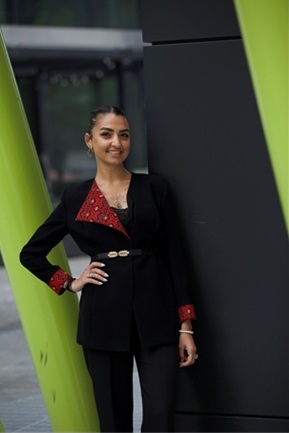
Hadil El-Baba (Valentina), Featured Facilitator, guiding the “From Self to System” facilitation journey
From Self to System
Facilitated by Hadil El-Baba (Valentina)
At the heart of the conference is a facilitated journey led by Hadil El-Baba (Valentina).
Across the weekend, her work unfolds as a continuous arc — guiding participants from inner awareness to relational presence, and from there into collective and systemic expression.
This journey explores peace not as an abstract idea, but as a lived and embodied practice — beginning within the individual and unfolding into relationships, cultures, and institutions.
Through reflection, dialogue, and collaborative exercises, participants examine how personal awareness, values, and relational habits shape the systems we co-create.
Rather than offering fixed answers, this facilitation opens a space for inquiry, connection, and co-creation — supporting participants in bridging inner transformation with real-world impact.
Human Grounding
A central experience in the programme is the HUMAN film screening and dialogue, facilitated by Carmel Irandoust, followed by her plenary, What’s LOVE Got to Do with It?
Grounded in human stories and shared reflection, this space reconnects participants with dignity, vulnerability, and the lived human experience that underlies systems, institutions, and public discourse.
It offers an opportunity to listen across difference, deepen empathy, and return to the human heart of justice.
Contributors & Programme Highlights
The conference brings together practitioners working across law, sustainability, governance, education, the arts, technology, and community development:
Alexandra Samii
Practicing Peace in Fragmented Societies: Rebuilding Trust Through Community-Based Dialogue (plenary)
Hadil El-Baba (Valentina)
(plenary)
From Self to System – Parts I & II (workshop series)
Victoria W. Thoresen
A New Paradigm for Community Partnerships (workshop)
Svenja Tams
Exploring Next Generation Leadership through Intergenerational Dialogue (workshop)
J. Marcelino Kongo
Singing Reimagined Futures: Anthem Songwriting as Artivism for Social Healing, Unity, and Justice (workshop)
Brian D. Lepard
Seeking Global Justice: Bahá’í Visions for Legal Reforms to Promote Peace (plenary)
Becoming Practitioners of Global Justice. (workshop)
Maryam Nooh-Nezhad
When Narratives Diverge: Designing Just Institutions in Space Governance (workshop)
Marijn Beuling
Two Wings of a Bird: Transforming a Culture of Violence into a Culture of Peace (workshop)
Sylvia Karlsson-Vinkhuyzen
Practicing Peace with Nature – Exploring Dimensions of Transformative Change (workshop)
Arthur Lyon Dahl
Peace with Nature: Designing Global Environmental Governance (plenary)
Peace with Nature and Environmental Justice: Governance for the Earth System (workshop)
Balázs Heller
Peace Within, Peace in the World: Transforming Society Through Individual Spiritual Awakening (workshop)
Nicole Ccorimanya
Just You! Creative, hands-on art workshop (workshop)
Maja Groff
New Requirements for International Peacemaking in Tumultuous Times: The Psychological and Gender Equality Dimensions of Peacemaking in International Arenas (plenary)
Challenges and Solutions for Justice and Health in Institutions: the Perspective of Institutional Courage (workshop)
Carmel Irandoust
HUMAN Film Screening + Dialogue (plenary)
What’s LOVE Got to Do with It? (workshop)
Jean-Marie Nau
Practising Peace Without Insistence: How Non-Coercive Decision-Making Is Accomplished in Talk (plenary)
Steve Moses
The Aging Crisis and Compassionate AI: Why Practitioners of Peace Must Shape the Technology That Will Care for Two Billion People (plenary)
The full programme and detailed schedule will be shared with registered participants in the coming days.
Conference Flow
The conference is intentionally shaped as a progression across the weekend.
It begins with reflection on trust and fragmentation, moves through an experiential facilitation journey, expands into plenaries and workshops on global justice, environmental governance, institutional courage, dialogue, and creative practice, and creates space for integration through reflection, conversation, and shared experience.
Participants are invited to engage the theme at multiple levels:
• inner life and self-awareness
• relationships and dialogue
• community practice
• institutional life
• global and systemic questions
Space for Reflection and Connection
Alongside the formal sessions, the programme includes space for fellowship, devotional reflection, informal connection, and creative expression.
These moments are not separate from the conference purpose — they are part of how the weekend breathes.
They create room for reflection, friendship, conversation, creativity, and the kind of inner and collective integration that allows learning to settle more deeply.
Join the Process
The Justice Conference is not only a place to listen, and a space to participate.
Whether your work lies in community-building, education, law, governance, sustainability, dialogue, the arts, or institutional life, you are warmly invited into a shared exploration of what it means to help build more just, trustworthy, and life-giving systems.
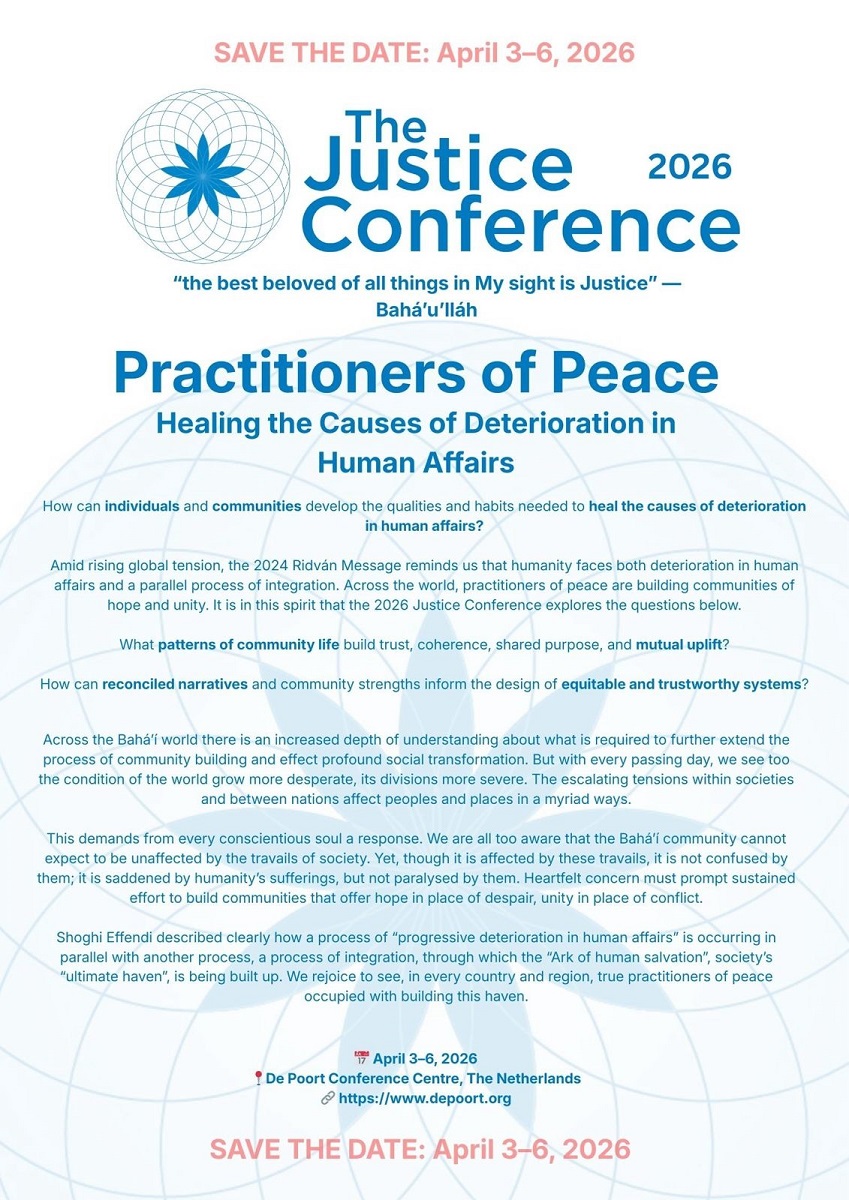
Theme: Practitioners of Peace 🕊️
Sub-theme: Healing the Causes of Deterioration in Human Affairs
Dates:
Start: Friday 3 April, 15hr (welcome and opening)
End: Monday 6 April, 14hr (after lunch)
Location: De Poort Conference Centre, Groesbeek, The Netherlands 🇳🇱
For over three decades, the Justice Conference has explored justice through inner coherence, healing and reconciliation, trust and consultation, systemic change, and community building.
In 2026, the conference turns to a vital next step:
How individuals, communities, and institutions become active practitioners of peace — capable of healing what is breaking down in human affairs and giving rise to enduring structures of justice.
Peace, in this context, is not merely an aspiration. It is a disciplined practice expressed in personal conduct, institutional integrity, and collective transformation.
The programme will include plenary talks, interactive workshops, panels, artistic contributions, and spaces for consultation and collective reflection.
Registration Now Open
Registration for Justice Conference 2026 is now open via the De Poort website.
Full Conference Fee
Day Guest Fees
Friday or Monday
• Standard: €20
• Discounted: €10
Saturday or Sunday
Standard: €30
• Discounted: €15
Accommodation & Meals
Accommodation is booked directly through De Poort Conference Centre.
Please note:
Accommodation prices listed on the De Poort website are per person, including when sharing a room.
Meals during the conference are included in the accommodation package.
For specific room configurations or booking-related questions, participants should contact De Poort directly.
Accommodation is guaranteed for registrations received up to two weeks before the start of the conference. Registrations received after this date remain welcome, and availability will be confirmed accordingly.
Taxi
You can book a taxi to and from De Poort yourself.
Common routes are to and from Nijmegen Central Station and Schiphol Airport.
You can easily book a taxi using the link below. Taxis are available for 1-4 people and for 5-8 people.
Conference De Poort | Taxi Service Nijmegen | Fixed Prices & Online Booking | Taxi Nijmegen | 024-8454020
For participants attending without overnight stay:
Please select the Dagarrangement 9/22 option. This day package includes lunch and dinner (without accommodation) and is the minimum required booking for non-residential participants.
If you would like a different (multi-person) room than the one listed on the registration form, please indicate this in the comments section. This is only possible if you indicate who you will be sharing the room with (please include names).
The other room options are:
Triple room with shared bathroom in the room
or
Triple room with shared bathroom in the hallway
or
Four-person room with shared bathroom in the hallway